

Building an independent house in Chennai requires careful planning around water security, long-term sustainability, and climate resilience. Water scarcity and seasonal torrential rainfall coexist in coastal Tamil Nadu, making on-site water management a mandatory architectural consideration rather than an optional eco-friendly upgrade. Installing a custom system for rainwater harvesting for home development ensures that every drop falling on your roof is either redirected for direct domestic consumption or routed back into local aquifers to replenish shallow groundwater tables. When designed during initial planning, rainwater harvesting systems integrate seamlessly into structural foundations, plumbing layouts, and site landscaping without requiring expensive post-construction retrofitting.
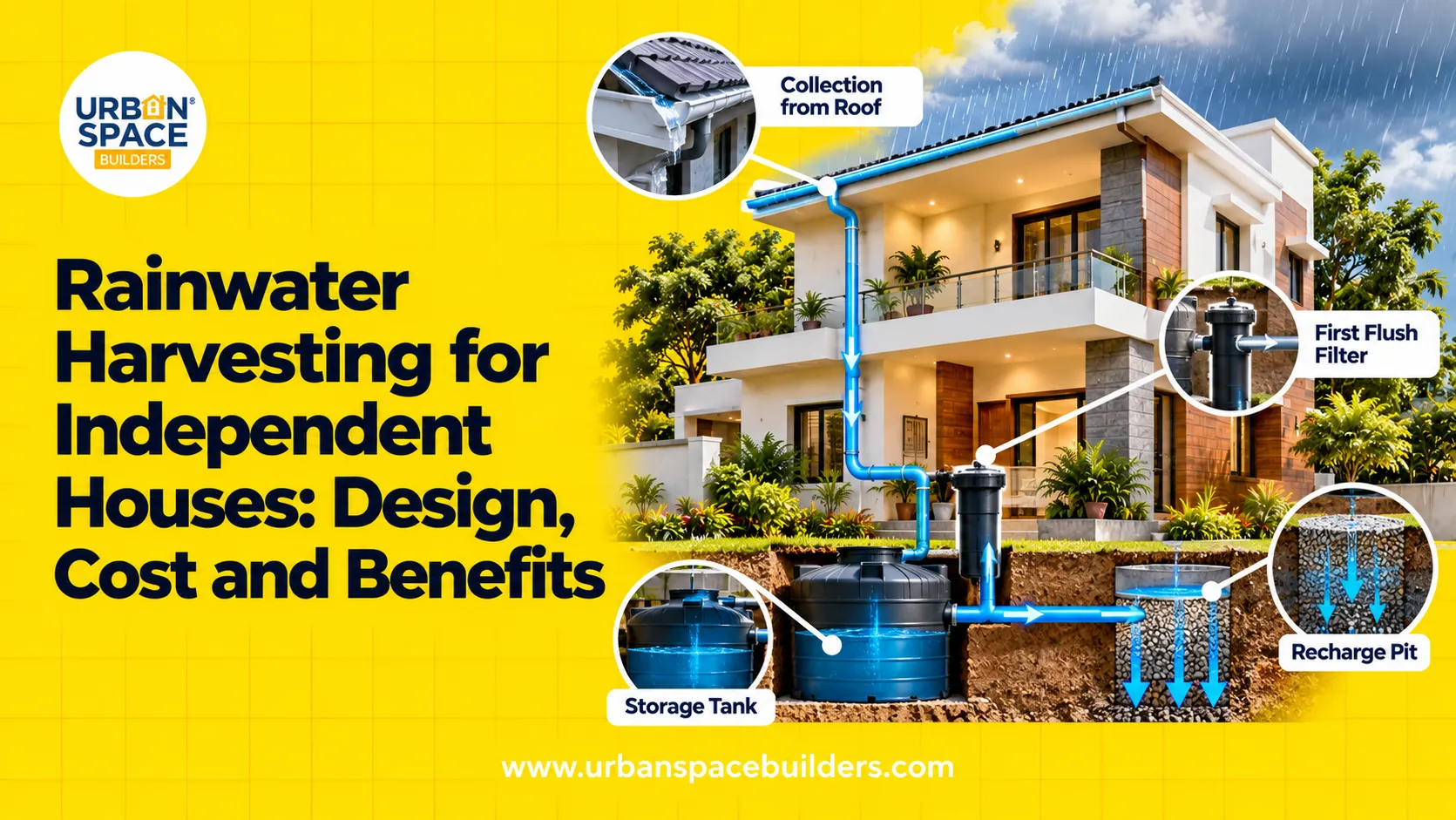
Integrating rainwater collection into residential construction helps homeowners manage municipal supply shortages, lower water dependency, and shield building foundations from unmanaged surface runoff. Modern rainwater management spans simple roof-to-tank diversion lines to high-capacity aquifer recharge wells and multi-stage filtration units. Partnering with experienced builders like about Urban Space Builders allows property owners to align site layout, structural design, and plumbing systems with environmental requirements and municipal planning guidelines across Chennai.
How does a rainwater harvesting system work for an independent home?
A residential rainwater harvesting system collects rain from roof surfaces, filters out debris, and directs clean water into storage tanks or groundwater recharge wells. Key components include catchment areas, conveyance pipes, first-flush diverters, multi-stage filter units, and storage reservoirs. Properly designed systems prevent soil erosion, lower water utility expenses, and replenish local aquifers efficiently.
By capturing rainfall directly at the source, homeowners reduce structural dampness caused by unmanaged perimeter splashback, mitigate localized yard flooding, and secure an auxiliary water source during extended dry summer months across coastal regions.
Understanding Residential Rainwater Harvesting Systems
Rainwater harvesting involves the direct collection, conveyance, filtration, and storage or percolation of atmospheric precipitation that falls on property footprints. For independent houses, the primary catchment area is usually the concrete terrace, sloped roof slab, or tiled roof structure. Rainwater falling on these surfaces is far cleaner than ground runoff, making roof catchments the ideal choice for domestic water harvesting systems.
An effective system operates through a structured hydrologic pipeline. Rainwater flows across clean roof surfaces into strategically positioned roof drain gulleys. Vertical downspout pipes then carry the water toward ground level. Before entering primary storage tanks or percolation structures, the initial flush of water containing dust, leaves, atmospheric pollutants, and bird droppings is automatically separated using a first-flush diverter valve. The secondary, clean stream of water flows through media filters—such as dual-bed sand filters, carbon units, or commercial mesh filters—to yield water suitable for non-potable or potable domestic applications.
In urban independent home design, rainwater harvesting structures fall into two functional pathways: direct storage harvesting and subterranean groundwater recharge. Direct storage systems channel filtered water straight into secondary underground sumps or above-ground storage tanks for immediate use in gardening, toilet flushing, clothes washing, or general domestic chores. Groundwater recharge systems, conversely, direct filtered rainwater into deep gravel-filled pits, perforated concrete recharge shafts, or abandoned borewells to raise regional water table elevations and improve surrounding groundwater quality.
Main Design Options and System Components
Choosing the correct design configuration depends on site dimensions, soil permeability, annual rainfall trends, family size, and available construction budget. Homeowners planning new independent houses can choose between rooftop collection, direct surface harvesting, direct storage, and groundwater recharge infrastructure.
1. Rooftop Catchment vs. Surface Catchment Systems
Rooftop catchments remain the gold standard for independent home construction because clean concrete slabs, clay tiles, and coated metal sheets yield relatively unpolluted runoff. RCC (Reinforced Cement Concrete) roofs treated with food-grade elastomeric or polyurethane waterproofing membranes prevent organic chemical contamination and provide smooth runoff flow. Surface catchments, which collect runoff from paved driveways, open courtyards, and garden paths, carry heavy loads of oil residue, silt, leaf litter, and bacterial contaminants. Surface runoff should never enter potable storage sumps; instead, it must pass through heavy-duty silt traps and oil-grease separators before discharging into dedicated groundwater recharge trenches along property boundary walls.
2. Underground Sumps vs. Above-Ground Storage Tanks
Underground storage sumps offer significant volumetric capacity without sacrificing valuable yard area or setback spaces. Constructed from reinforced RCC with high-density waterproofing additives or non-corrosive polyethylene shells, underground sumps insulate harvested water from ambient summer heat, preventing algae blooms. Above-ground tanks, typically manufactured from triple-layer UV-stabilized rotational molded polyethylene, are less expensive and easier to inspect, but they occupy usable ground area and exposed water can heat up during summer months.
3. Filtration Systems: Sand-Gravel Filters vs. Cartridge and Mesh Units
Filtration is the critical operational link between raw rainwater catchment and usable domestic supply. Common filtration setups for independent houses include:
- Slow Sand and Media Filters: Built using stacked concrete chambers containing layers of coarse gravel, medium pebble beds, activated charcoal, and graded quartz sand. These units trap fine silt, organic particulate matter, and color impurities through mechanical straining and physical adsorption.
- Modular Inline Pressure Filters: Compact commercial filter units containing high-density stainless steel mesh (100 to 200 mesh size) or dual-stage polymeric cartridge filters installed directly on vertical downspout drops. They save floor space and feature simple backwash valves for fast maintenance.
- First-Flush Diverters: Mechanical float-valve pipes or manual gate-valve bypass channels that isolate and discard the first 1 to 2 millimeters of rainfall per square meter of roof area during each rain event.
4. Recharge Wells and Injection Shafts
Where plot area constraints prevent large underground sumps, artificial groundwater recharge structures provide an efficient solution. Recharge wells are vertical shafts lined with perforated RCC rings, ranging from 3 to 6 feet in diameter and extending 12 to 30 feet deep depending on localized lithology and soil layers. Surrounding the perforated rings with coconut fiber matrix wrapped around graded gravel and coarse sand forms an effective filter zone. This enables incoming rainwater to percolate rapidly into underlying aquifer formations without eroding adjacent foundation footings.
Planning and Construction Cost Factors
Budgeting for a residential rainwater harvesting system requires understanding the structural, mechanical, and site factors that govern installation costs. Rather than looking at generic lump-sum figures, homeowners should evaluate cost variables across structural execution, plumbing networks, filtration tech, and excavation parameters.
1. Catchment Area Dimensions and Roof Waterproofing Scope
The total square footage of usable roof area dictates pipe diameter sizing, drainage gulley density, and filter volume requirements. Larger roof areas collect massive volumetric surges during intense tropical downpours, requiring larger downspouts (110 mm to 160 mm PVC pipes) and higher-capacity filter housings. Additionally, applying durable waterproofing layers—such as food-grade acrylic polymer coatings—to concrete roof slabs ensures water remains untainted by concrete salts or efflorescence.
2. Storage Sump Sizing and Excavation Requirements
Constructing an RCC underground sump accounts for a significant portion of overall system costs. Excavation depth, soil retention bracing, structural rebar reinforcement steel, concrete volume, and specialized crystalline waterproofing compounds directly influence financial outlays. High water tables or rocky subterranean layers increase excavation complexity and require specialized mechanical equipment or shoring safety works.
3. Filtration System Complexity
Basic brick-masonry gravel-sand filters are relatively inexpensive to construct using locally sourced materials. Conversely, self-cleaning stainless-steel dual-stage inline filters, automatic electronic backwash systems, or secondary UV/Ozone disinfection units added for potable supply integration increase initial equipment costs while reducing manual cleaning labor over time.
4. Plumbing Pipe Sizing, Valves, and Diverter Networks
Selecting heavy-duty UV-resistant UPVC or HDPE piping for all exposed vertical downspouts and below-ground connection trenches prevents pipe cracking and UV degradation. Adding heavy-duty brass full-port ball valves, automatic float switches, stainless-steel leaf screens, and inspection chambers increases upfront plumbing material costs but ensures long-term system durability.
To better understand comprehensive building allocations and civil works planning, homeowners can review detailed construction packages that clearly outline foundation, plumbing, waterproofing, and structural scope options for independent home construction.
Step-by-Step Design Framework and Capacity Calculation
Designing a reliable rainwater harvesting system requires accurate hydrological calculations to size storage reservoirs and recharge shafts properly without over-engineering or under-sizing structural elements.
Step 1: Calculate Total Annual Harvesting Potential
The potential volume of rainwater an independent house can capture annually is calculated using the standard empirical hydrologic formula:
Annual Harvested Volume (Liters) = Catchment Area (sq. m) × Average Annual Rainfall (mm) × Runoff Coefficient × Collection Efficiency Factor
- Catchment Area: Horizontal projection area of the roof measured in square meters.
- Average Annual Rainfall: Local annual precipitation depth recorded in millimeters.
- Runoff Coefficient: Efficiency of surface material to yield water flow. Smooth RCC slabs treated with smooth coatings typically exhibit a runoff coefficient of 0.80 to 0.85, whereas clay tiles average 0.75, and unpaved surface ground drops to 0.10 to 0.20.
- Collection Efficiency Factor: Accounts for first-flush losses, evaporation, and minor splash loss (typically assumed as 0.90).
For example, a home with a 150-square-meter RCC roof slab in a coastal region receiving 1,400 millimeters of annual rainfall yields an estimated annual harvestable volume of:
150 sq. m × 1,400 mm × 0.85 × 0.90 = 160,650 Liters of water per year.
Step 2: Determine Optimum Storage Sump Volume
To size direct storage sumps for domestic consumption, apply the operational dry-period demand model. Sizing a sump to hold an entire year’s rainfall is structurally impractical and financially unviable. Instead, size storage reservoirs to bridge critical dry spells or hold peak rainfall sequences across short heavy monsoon bursts.
Storage Sump Volume (Liters) = Daily Domestic Demand (Liters) × Desired Autonomy Days
If a 4-person family consumes approximately 500 Liters of non-potable water daily for flushing, washing, and garden maintenance, and aims for a 30-day reserve buffer during monsoon breaks:
500 Liters/day × 30 Days = 15,000 Liters optimum sump capacity.
Step 3: Size Groundwater Recharge Wells
When roof water runoff exceeds sump storage capacity, surplus water must redirect into groundwater recharge shafts. Sizing a recharge well requires estimating peak hourly rainfall intensity rather than annual averages. Calculate peak hourly volume using regional maximum intensity figures (e.g., 50 mm/hour during peak monsoon bursts). The recharge pit chamber volume must store peak hourly inflow temporarily while allowing natural percolation through porous soil strata over a 2- to 4-hour absorption period.
Quality Standards, Material Specifications, and Maintenance Guidelines
Long-term operational efficiency relies on strict material selection criteria and a simple, periodic preventative maintenance routine.
1. Construction Material Specifications
- Concrete Sump Mix: Structural sumps must utilize M25 or M30 grade concrete with a low water-cement ratio, reinforced with corrosion-resistant TMT steel bars. Integrating crystalline waterproofing admixtures into the concrete mix fills micro-capillaries, preventing leakages and structural dampness.
- Plumbing Lines: Use Class 3 or Schedule 40 UV-stabilized UPVC pipes for downspout lines. Below-ground conveyance runs should utilize Class 4 UPVC or high-density polyethylene (HDPE) pipes laid over an engineered sand bedding layer to absorb soil settlement pressure.
- Filter Media: Ensure sand filter units feature washed, graded silica quartz sand (0.5 mm to 1.5 mm grain size) supported by river pebble beds (5 mm to 20 mm size). Avoid unwashed pit sand containing organic mud or reactive silts that degrade water clarity.
2. Preventative Maintenance Operations
A well-maintained rainwater harvesting system provides continuous high-quality water for decades. Homeowners should establish an easy periodic maintenance routine:
- Pre-Monsoon Roof Clearing: Clear all leaves, organic silt, dust, and debris from rooftop surfaces, roof drain sumps, and gutter lines prior to initial seasonal rains.
- First-Flush Valve Reset: Clean out the sedimentation chamber of the first-flush diverter unit after every major rainstorm to prevent silt buildup from entering filter chambers.
- Filter Media Washing: Wash and backflush inline stainless-steel mesh filters monthly during monsoon periods. For sand-gravel media filters, remove top sand layers annually, wash thoroughly with clean water to remove trapped bio-slimes, and replenish as needed.
- Sump Disinfection: Disinfect underground storage sumps annually using food-grade hydrogen peroxide solutions or mild chlorination treatments following complete drain-down and silt removal.
Common Mistakes Homeowners Make in System Design
Improperly engineered rainwater harvesting installations can cause structural issues, low filtration efficiency, or water contamination. Avoiding these common mistakes preserves system utility and structural integrity:
1. Omitting First-Flush Diverters
Connecting downspout lines straight from roof catchments into media filters or storage sumps without a first-flush diverter introduces heavy organic debris, air pollutants, and bird droppings directly into storage vessels. This clogs media filters prematurely and causes anaerobic bacterial decomposition inside sumps, creating bad odors and discolored water.
2. Placing Recharge Wells Too Close to House Foundations
Locating high-volume percolation shafts or unlined recharge pits adjacent to structural footings can oversaturate subsoil under foundation zones. In soils with high clay content, soil expansion and reduction caused by localized moisture swings can lead to micro-settlement cracks in perimeter grade beams and compound walls. Keep recharge wells at least 3 to 4 meters away from main building load-bearing walls.
3. Combining Sewage or Graywater Plumbing with Rainwater Lines
Rainwater collection pipes must remain completely independent from greywater (washbasin and shower drains) and blackwater (toilet waste) systems. Cross-connecting rainwater collection lines with greywater lines contaminates pristine rainwater sumps with soap scum, surfactants, pathogens, and grease, rendering the harvested water unsafe even for garden irrigation.
4. Neglecting Sump Overflow Provisioning
Every direct storage sump requires an oversized, pest-screened emergency overflow pipe positioned above the top water level line. If extreme rainfall fills a sump past capacity, unmanaged overflow can back up into ground floor plumbing fixtures or flood surrounding parking areas. Overflow outlets should discharge safely into secondary groundwater recharge wells or street stormwater drains through non-return check valves.
Chennai-Specific Considerations: Climate, Soil and Regulations
Planning a system for independent homes in coastal Tamil Nadu requires adapting design details to local climatic parameters, hydrogeological zones, and municipal mandates across Chennai.
1. Coastal Monsoonal Patterns
Chennai experiences distinct rainfall cycles, receiving moderate precipitation during the Southwest Monsoon (June to September) followed by intense downpours during the Northeast Monsoon (October to December). Storm events during the Northeast Monsoon often drop massive volumes of rain within short timeframes. Downspout pipes, roof drains, and filter inflow channels must be sized for high hourly peak discharge rates rather than uniform light rain.
2. Hydrogeology and Varied Soil Formations
Subterranean geology varies across different zones of Chennai, directly influencing groundwater recharge design choices:
- Coastal Sandy Belts (e.g., ECR, OMR, Besant Nagar): Sandy subsoils offer high percolation rates. Deep gravel-filled recharge shafts absorb surface water rapidly, making shallow percolation shafts and deep injection wells efficient at restoring local freshwater lenses along coastal aquifers.
- Clay Formations (e.g., Velachery, Anna Nagar, Tambaram): Clay subsoils exhibit low natural permeability. Standard shallow soak pits fill up quickly and drain slowly. Properties in heavy clay zones require deeper recharge shafts penetrating past impervious clay strata into underlying weathered rock or fractured aquifers, complemented by larger direct storage sumps.
- Rocky Substrata (e.g., Guindy, Pallavaram): Hard granite beds limit manual pit digging depth. In these locations, wide-diameter shallow recharge trenches with extended horizontal distribution runs offer better infiltration performance than narrow vertical bore shafts.
3. Municipal Approval Norms and Planning Mandates
Rainwater harvesting is a mandatory statutory requirement for obtaining building completion certificates and utility connections in Chennai. Municipal planning guidelines enforced by civic bodies require comprehensive RWH design layouts in all submitted residential floor plans. To review official planning rules, setback requirements, and building permits, homeowners can consult the Greater Chennai Corporation town-planning information portal and verify building layout submission standards on the CMDA planning-permission portal.
Role of Professional Engineering in RWH Integration
While basic rainwater harvesting concepts seem simple, integrating efficient systems into modern independent home construction requires professional engineering oversight. A qualified structural and MEP (Mechanical, Electrical, Plumbing) engineering team ensures that:
- Catchment slope angles allow self-cleansing runoff velocities without overflowing perimeter parapet walls.
- Underground RCC sumps withstand lateral soil earth pressure and subterranean buoyant uplift forces when empty during high water table conditions.
- Subsurface recharge shafts are positioned safely outside structural load-distribution cones to protect foundation footings.
- Secondary pumping systems, automated level switches, and dual-plumbing supply circuits operate without airlocks or back-siphonage risks.
Homeowners exploring custom residential design options can learn more about comprehensive engineering and architectural design approaches on our residential construction services page.
Integrating Rainwater Harvesting with Urban Space Builders
At Urban Space Builders, we treat rainwater management as an integral element of residential structural design rather than an afterthought. When partnering with our engineering and design teams for independent home projects in Chennai, we help homeowners integrate sustainable water solutions from initial site analysis through final plumbing handovers.
To help us customize an optimal rainwater harvesting system for your plot, consider preparing the following details before project discussions:
- Plot Boundary Dimensions & Layout Drawings: Helps determine available setback space for underground sumps, driveways, and perimeter recharge trenches.
- Roof Slab Area & Structural Specifications: Enables accurate annual runoff yield calculation and pipe network sizing.
- Site Subsoil Observations: Information regarding local water table levels, soil composition (sandy, clayey, or rocky), and existing borewell depths.
- Expected Domestic Occupancy: Assists in balancing underground sump storage capacity with planned household non-potable water consumption needs.
- Material Preferences: Choice between integrated masonry filters, modular inline commercial units, or advanced secondary UV filtration setups.
Exploring past structural work and custom residential architectural layouts on our Urban Space Builders projects page demonstrates how integrated civil planning delivers long-term utility, durability, and functional value.
Conclusion
Designing a reliable rainwater harvesting system for your independent house secures household water independence, protects your building foundation from improper drainage, and contributes directly to local groundwater restoration. By calculating runoff yields, selecting robust filtration systems, balancing direct storage with recharge wells, and adhering to regional soil and municipal guidelines, homeowners can build a sustainable, trouble-free water management system that lasts for generations.
Ready to plan your sustainable dream home in Chennai? discuss your project with Urban Space Builders today to get expert architectural design guidance, tailored structural planning, and transparent construction estimates for your upcoming home.
Frequently Asked Questions
What is the minimum roof area needed for rainwater harvesting at home?
There is no strict minimum roof area requirement for implementing rainwater harvesting. Even small terrace footprints of 400 to 500 square feet generate significant harvestable runoff during standard rainstorms. The key is sizing downspouts, filtration units, and collection sumps proportionally to the available catchment area.
Can harvested rainwater be used directly for drinking and cooking?
Harvested rainwater collected from clean roofs is naturally soft and low in minerals, but it shouldn’t be consumed directly without secondary purification. Raw rainwater can gather atmospheric dust, pollen, and roof-surface microbial matter. Passing water through multi-stage media filters, micro-filtration cartridges, and boiling or UV/RO purification systems renders it safe for drinking.
How often should rainwater harvesting filters be cleaned or replaced?
Filter maintenance depends on system design and local rainfall patterns. First-flush diverter chambers and leaf strainers should be cleaned after every major rainstorm during the monsoon season. Modular mesh filter cartridges require rinsing monthly, while sand and gravel media beds should be backwashed twice per season and thoroughly replaced or sanitized once every two to three years.
What is the difference between direct storage harvesting and groundwater recharge?
Direct storage harvesting diverts filtered rainwater straight into above-ground tanks or underground RCC sumps for immediate household use like toilet flushing, laundry, and gardening. Groundwater recharge, conversely, channels rainwater through perforated shafts or gravel pits into natural underground aquifers, restoring soil moisture and raising regional water tables.
Does a rainwater harvesting system require regular mechanical pumping?
Rainwater flows naturally from roof catchments down to filters, sumps, and recharge wells via gravity without requiring electric pumps. However, transferring water stored in underground sumps up to overhead house distribution tanks for daily household use requires a standard domestic motor pump connected to float switches.
How do local soil conditions in Chennai affect recharge well design?
Soil permeability dictates recharge well efficiency. Sandy coastal soils (like ECR and OMR) allow rapid natural water percolation through simple vertical shafts. Conversely, heavy clay soils (found in Velachery or Tambaram) drain slowly, requiring deeper percolation shafts that penetrate clay layers down to porous rock or fractured strata to recharge aquifers effectively.
Can I retrofit a rainwater harvesting system on an existing home?
Yes, existing independent houses can be retrofitted by redirecting exterior vertical downspouts into centralized collector pipes leading to a surface filter unit and recharge pit. However, integrating RWH during new house construction allows builders to construct underground sumps and concealed plumbing routes far more efficiently and cost-effectively.
Is rainwater harvesting mandatory for independent houses in Chennai?
Yes, implementing rainwater harvesting infrastructure is a statutory legal mandate under Tamil Nadu state regulations and municipal building rules. Residential construction plans submitted to civic planning authorities like CMDA and Greater Chennai Corporation must include approved rainwater harvesting designs to secure building approvals and utility connections.