

Managing a reliable water supply is a primary concern for independent homeowners in Chennai. With seasonal monsoons followed by dry summer months, groundwater levels fluctuate significantly across different neighbourhoods. Setting up an efficient system for rainwater harvesting for home planning allows property owners to capture clean runoff, recharge local aquifers, and reduce reliance on external water tankers. When planning a new build or major structural overhaul, integrating sustainable water management from the design stage ensures long-term efficiency and structural safety. At Urban Space Builders, our residential construction services help homeowners understand how thoughtful architectural design and proper site planning turn natural rainfall into a valuable domestic resource. Learning how rainwater harvesting works, what drives installation costs, and how to select the right system layout empowers families to make practical construction decisions for their independent houses.
What Is the Best Rainwater Harvesting Setup for an Independent House?
The best rainwater harvesting setup for an independent house combines rooftop catchment filtration with dual destination storage: direct secondary storage tanks for domestic utility use and groundwater recharge wells to replenish the local water table. The optimal capacity and configuration depend on roof surface area, annual local rainfall, soil permeability, and household water consumption requirements.
Understanding Rainwater Harvesting Components for Independent Houses
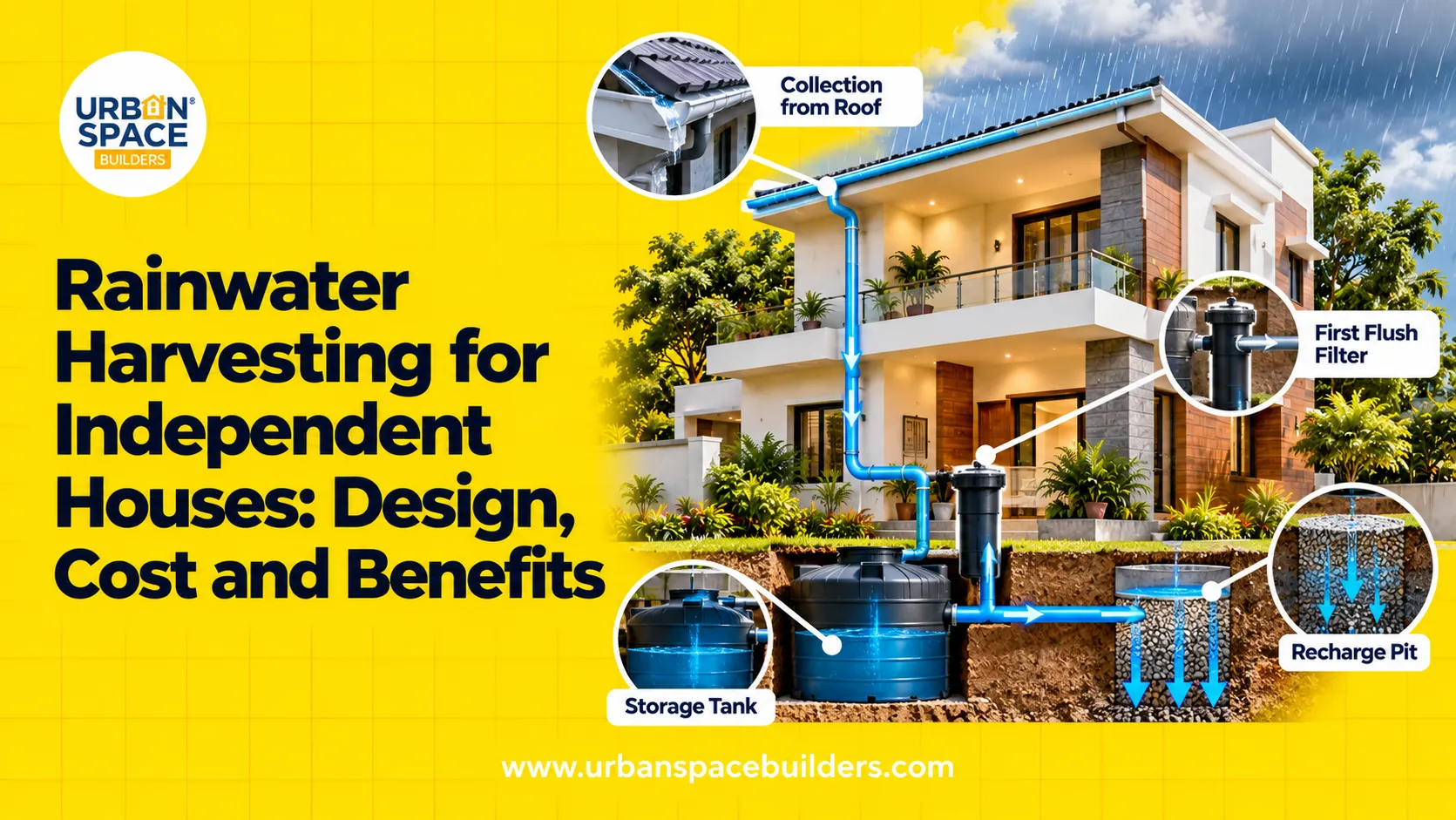
A residential rainwater harvesting system collects rainfall from elevated surfaces, filters out debris, and directs the water into dedicated storage structures or sub-surface recharge shafts. Designing an effective system requires understanding how each component functions within the overall plumbing and structural layout of the house.
1. Catchment Surface and Conveyance Pipes
The roof area serves as the primary catchment zone for residential collection. Smooth, impervious surfaces like concrete slabs, clay tiles, or metal sheeting yield high runoff efficiency. Conveyance pipelines, typically constructed from high-density uPVC, transport water from roof drains to filtration units. Proper pipe sizing and slope gradient prevent overflow and silt buildup during heavy downpours.
2. First-Flush Diverters
The first atmospheric rainfall washes dust, leaves, and organic particles off the roof. A first-flush diverter isolates and discards this initial volume before water enters the storage or recharge system. Automatic mechanical diverters or manual valve arrangements ensure that only cleaner, secondary-stage water proceeds into the main filtration system.
3. Filtration Units
Filtration removes suspended solids, fine silt, and organic matter from runoff. Residential systems commonly use multi-stage media filters containing layers of coarse sand, gravel, activated charcoal, and mesh strainers. Compact modular pressure filters or modular dual-chamber concrete filter boxes can also be integrated into ground-level service spaces.
4. Storage Structures and Recharge Systems
Filtered water can be directed into sumps for immediate non-potable use or routed into recharge wells to replenish local groundwater. Surface or underground masonry sumps hold water for gardening, flushing, and washing. Recharge shafts, filled with filter media and perforated rings, allow water to percolate deeply into soil strata, lifting the local water table.
Rooftop Harvesting vs. Groundwater Recharge: Choosing the Right Strategy
Homeowners often evaluate whether to store rainwater directly in sumps or inject it into underground aquifers through recharge pits. Both approaches offer unique advantages depending on site conditions and space availability.
Direct rooftop storage captures clean water in an underground sump or overhead tank, making it immediately available for household chores. This reduces daily reliance on municipal supply lines and water delivery trucks. However, storage capacity is limited by tank dimensions and available ground area. Once tanks reach full capacity, excess water must be safely diverted.
Groundwater recharge wells focus on long-term water security by guiding runoff into soil layers. In areas with permeable soil strata, recharge pits effectively replenish depleted borewells. Recharge systems require less surface space than large storage sumps, making them highly suitable for compact plots. Many comprehensive residential designs combine both strategies, directing initial yields into storage sumps and overflow volumes into recharge wells.
Key Factors Influencing Rainwater Harvesting Costs and Budgets
When budgeting for rainwater harvesting, homeowners should evaluate project-specific factors rather than relying on generic estimates. System expenses depend directly on property dimensions, material specifications, and site conditions. Clarifying these scope details with your building team ensures financial transparency.
Plot Area vs. Catchment Area
It is crucial to distinguish between total plot area and actual roof catchment area when planning your budget. Total plot area reflects property boundary dimensions, whereas catchment area refers specifically to the roof surface collecting rainwater. Construction proposals calculate piping runs, drain counts, and filter sizing based on catchment area and anticipated flow volume, not overall land size.
Material Specifications and Equipment Scope
The choice of materials significantly impacts system durability and overall investment. Standard uPVC piping, basic sand-gravel filter pits, and brick-masonry sumps offer cost-effective options. Premium setups featuring food-grade stainless steel filters, automatic first-flush diverters, submerged booster pumps, and reinforced concrete sumps require higher upfront capital. Review written quotations to confirm whether pump installations, electrical connections, and masonry enclosures are included in the scope.
Site Conditions and Soil Characteristics
Subgrade conditions affect excavation difficulty and structural depth requirements. Rocky terrain or hard clay soils increase manual or mechanical excavation costs for underground sumps and deep recharge shafts. Sandy soils allow rapid percolation, reducing recharge well depth, whereas low-permeability clay requires deeper bore shafts or enlarged filter chambers. Soil testing helps identify optimal recharge depth and structural requirements.
Integrating Systems During New Construction vs. Retrofitting Existing Homes
Incorporating rainwater collection into new home planning offers significant design flexibility and efficiency compared to retrofitting mature properties.
During initial construction, plumbing lines, filter chambers, and recharge shafts can be seamlessly planned alongside foundations and drainage networks. Architectural drawings account for slope gradients, underground utility placement, and sump positioning. Homeowners reviewing construction packages should verify how drainage layouts, sump capacities, and filtration components are defined within the base contract agreement.
Retrofitting an existing house involves routing external downspouts across finished facades and excavating around established paving. Structural considerations must be assessed when connecting new pipelines to existing sumps or borewells. Engaging qualified professionals for structural assessment ensures that excavations near existing foundations do not compromise building stability.
Local Regulations and Approval Standards in Chennai
Rainwater harvesting is a mandatory requirement for residential construction in Chennai to combat seasonal water distress and preserve coastal groundwater balance. Municipal regulations require independent residential buildings to install functional collection or recharge facilities before securing completion certificates and utility connections.
Homeowners should review guidance from local planning bodies when submitting architectural plans. Property owners can verify site planning guidelines through the Greater Chennai Corporation town-planning information portal or inspect submission requirements on the official CMDA planning-permission portal. Ensuring compliance during the design phase prevents delays during building inspections and approval clearances.
Maintenance Best Practices for Sustainable Performance
Regular system maintenance preserves water quality and prevents clogging in pipes and filter beds. Simple seasonal routines keep systems functioning efficiently for decades.
- Pre-Monsoon Inspection: Clear leaves, dust, and debris from roofs, gutters, and downspouts before the rainy season starts.
- Filter Media Cleaning: Wash or replace sand, gravel, and mesh filter elements periodically to maintain flow velocity and filtration efficiency.
- First-Flush Reset: Clean out first-flush diverter chambers after heavy initial monsoons to ensure continuous automatic operation.
- Sump Sanitation: Inspect storage sumps annually for silt settlement and clean interior walls before major rainfall periods.
- Recharge Well Clearance: Inspect recharge pits for silt accumulation to preserve percolation rates into surrounding soil strata.
Discussing Your Project with Urban Space Builders in Chennai
Designing a reliable rainwater harvesting system requires balancing structural integrity, storage capacity, and local regulatory mandates. If you are planning to construct a new independent home in Chennai, working with experienced builders ensures every component is engineered to match your plot characteristics.
Before initial design consultations, homeowners can gather helpful details, including plot dimensions, architectural preferences, estimated daily household water usage, and target construction timelines. Exploring previous Urban Space Builders projects offers clear insights into how modern structural designs seamlessly integrate utility storage, drainage pathways, and aesthetic finishes. Learn more about Urban Space Builders and our engineering methodology for contemporary urban living.
Conclusion
Installing a well-engineered rainwater harvesting system provides independent houses in Chennai with a resilient water supply while protecting local groundwater reserves. By considering catchment area, soil conditions, and maintenance needs early in the planning process, homeowners establish long-term utility security for their families. If you are preparing to build or renovate your home, discuss your project with Urban Space Builders to receive project-specific guidance tailored to your property requirements.
Frequently Asked Questions
Can harvested rainwater be used for drinking purposes?
Harvested rainwater collected from residential roofs can be used for non-potable household applications like flushing, gardening, and washing. For potable consumption, water must undergo advanced multi-stage filtration, disinfection, and laboratory testing to ensure safety standards are fully met.
How deep should a groundwater recharge well be dug?
Recharge well depths depend on soil permeability, local water table levels, and subgrade rock formations. Typically, recharge shafts reach depths between 15 to 30 feet to breach clay layers and access permeable sand strata, though professional hydrogeological verification is recommended.
What is the difference between a package rate and total project budget?
A package rate covers specific agreed-upon construction deliverables per square foot of chargeable area as outlined in a contract. A total project budget includes the package rate subtotal plus external items such as municipal approval fees, utility connections, specialized filtration equipment, interior fittings, and site preparation.
How often should rainwater filter media be replaced?
Physical filter media such as sand and gravel should be washed before each monsoon season and replaced every 2 to 3 years. Removable mesh cartridges or active carbon inserts should be cleaned every few months during heavy usage periods and replaced according to manufacturer guidelines.
Is rainwater harvesting mandatory for all independent homes in Chennai?
Yes, installation of rainwater harvesting structures is legally mandatory for all residential buildings across Chennai under local municipal regulations. Compliance must be demonstrated during building inspections to obtain formal completion certificates and municipal water connections.