

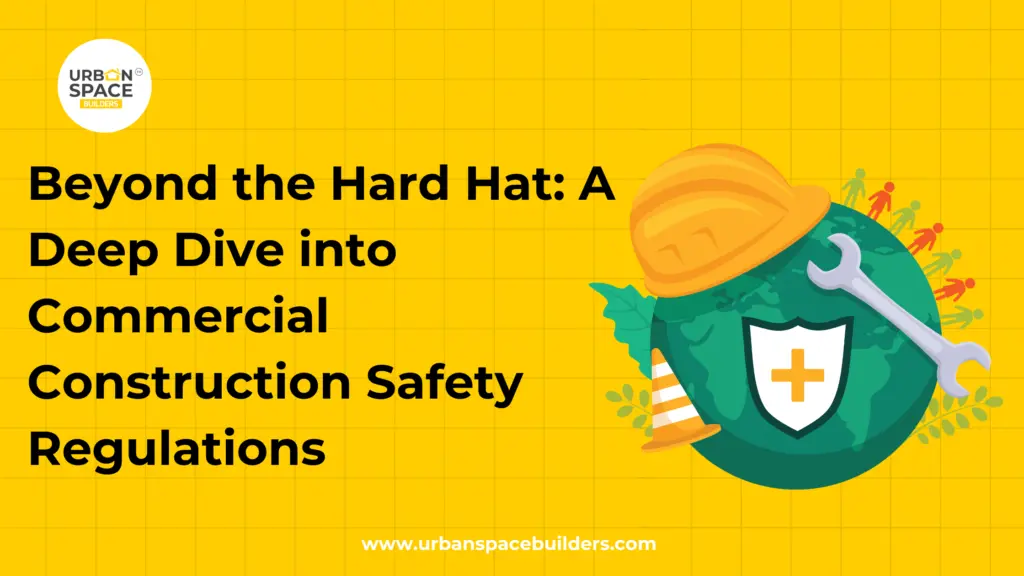
Beyond the Hard Hat: A Deep Dive into Commercial Construction Safety Regulations
Beyond the Hard Hat: A Deep Dive into Commercial Construction Safety Regulations When it comes to commercial construction, safety is far more than a yellow hard hat. While Personal Protective Equipment (PPE) is crucial, true safety stems from construction safety regulations, meticulous planning, continuous training, and strict adherence that ensure every worker returns home safely. Leading Urban Space Builders, one of the top construction companies in Chennai, emphasize that safety is not just compliance, it’s a culture. Let’s take a closer look at the essential construction site safety rules and regulations, their enforcement, and why modern commercial building projects must prioritize them. Why Commercial Construction Safety Is Not Negotiable Commercial building projects involve heavy machinery, electrical systems, high-rise structures, and multiple subcontractors. Even a small oversight can result in serious injuries, legal consequences, and financial loss. Safety rules are mandatory, not optional, and failure to follow them can be costly in every sense. Proper adherence to regulations also ensures that commercial building construction cost stay within budget by preventing fines and work stoppage Key Construction Safety Regulatory Agencies 1. OSHA (Occupational Safety and Health Administration) The OSHA full form is Occupational Safety and Health Administration. OSHA is the primary federal authority overseeing workplace safety in the U.S., enforcing standards that cover everything from scaffolding to fall protection. 2. Local and State Building Codes Each municipality or state can have its own codes for safety. The local codes usually augment federal regulations to cover regionally specific hazards. 3. ANSI (American National Standards Institute) The ANSI full form is American National Standards Institute. ANSI facilitates the development of consensus safety procedures industry-wide. Not legally enforceable, yet numerous OSHA standards are derived from ANSI guidelines. Most Important Safety Regulations Applied to Commercial Construction Fall Protection (OSHA Standard 1926.501) Falls are one of the top causes of death in construction. OSHA mandates that fall protection be offered at heights of six feet or greater in construction. Guardrails, safety nets, and personal fall arrest systems are enforced. Scaffolding Safety (OSHA Standard 1926.451) Scaffolds that were not built or used correctly are a tremendous risk. OSHA requires correct training, load capacity, and fall protection for all to use scaffolding. Hazard Communication (OSHA Standard 1926.59) All employees need to be notified of the dangerous substances they will be working with. This is done through labeling, data sheets (SDS), and proper handling. Personal Protective Equipment (PPE) Employers are responsible for supplying and requiring the use of appropriate Personal Protective Equipment (PPE), such as hard hats, gloves, goggles, and high-visibility vests. Electrical Safety Working around or with electricity means following lockout/tagout protocols, grounding practices, and equipment maintenance to avoid electrocution. Crane and Hoisting Equipment Regulations Operators need to be certified, and equipment inspected regularly. Load limits and correct signaling procedures are required. Training and Documentation Requirements Training is as vital as equipment. OSHA mandates employers to ensure safety training in the employees’ language and vocabulary. Training has to be properly documented and updated regularly, particularly when implementing new procedures or equipment. Construction contractors also have to keep records of injuries and illnesses and report severe events in a timely manner. Site-Specific Safety Plans (SSSP) Every commercial construction project must have a site-specific safety plan that addresses its specific hazards. It contains: Emergency policies Evacuation paths Incident response procedures Hazards identification Toolbox talks daily Implementing these plans fosters a strong safety culture while ensuring compliance with OSHA standards. Learn more about optimizing construction processes and how to save money while building your dream home. Common Violations and Their Consequences Failure to provide fall protection Unsafe scaffolding Poor hazard communication Misuse of ladders Violations can cost anywhere from a few thousand dollars up to over $100,000 per case. Even worse, a serious accident or death can spawn lawsuits, stoppages in work, and irreversible harm to a company’s reputation. The Role of Technology in Construction Safety Drone technology, wearable devices, and real-time monitoring systems are turning into game-changers in the enforcement of safety. They assist in detecting risks, monitoring compliance, and enhancing response times for incidents. For insights into planning safe and compliant projects, check understanding the CMDA approval process for construction in Chennai. Conclusion: Building Safely Is Building Smart Safety is more than rule-following; it’s about protecting lives, fostering trust, and ensuring project success. By understanding and implementing the full spectrum of construction safety rules and regulations, commercial building construction companies and commercial construction services providers can create environments where workers feel secure and valued. Because behind every hard hat is a human being, and keeping that person safe is the ultimate responsibility. Recent Posts The Future of Cities: Apartments and the Growth of Vertical Living The Future of Cities: Apartments and the Growth of Vertical … How Structure Design Ensures Long-Lasting Homes Smart Home Technology: Enhancing Space Efficiency in Modern Residences Today, … Let’s Build Your Dream Home Now! Book a Consultation The Future of Cities: Apartments and the Growth of Vertical Living admin • September 25, 2025 • Uncategorized • No Comments The Future of Cities: Apartments and the Growth of Vertical Living In today’s fast-paced world, cities are growing upward rather than outward, … How Structure Design Ensures Long-Lasting Homes admin • September 24, 2025 • Uncategorized • No Comments Smart Home Technology: Enhancing Space Efficiency in Modern Residences Today, houses are seen as more than simple living spaces. They have become … The Role of Quality Construction in Increasing Property Value admin • September 17, 2025 • Uncategorized • No Comments Smart Home Technology: Enhancing Space Efficiency in Modern Residences Today, houses are seen as more than simple living spaces. They have become … Smart Home Technology: Enhancing Space Efficiency in Modern Residences admin • September 12, 2025 • Uncategorized • No Comments Smart Home Technology: Enhancing Space Efficiency in Modern Residences Today, houses are seen as more than simple living spaces. They have become …